personal benchmark: 144,868
i reached the 8,192 tile in 4,913 moves with a final score of 144,868. playing past 8k by hand requires thousands of consistent moves without a mistake, so i wanted to build an ai system that could play at this level and reach 16,384 and 32,768.
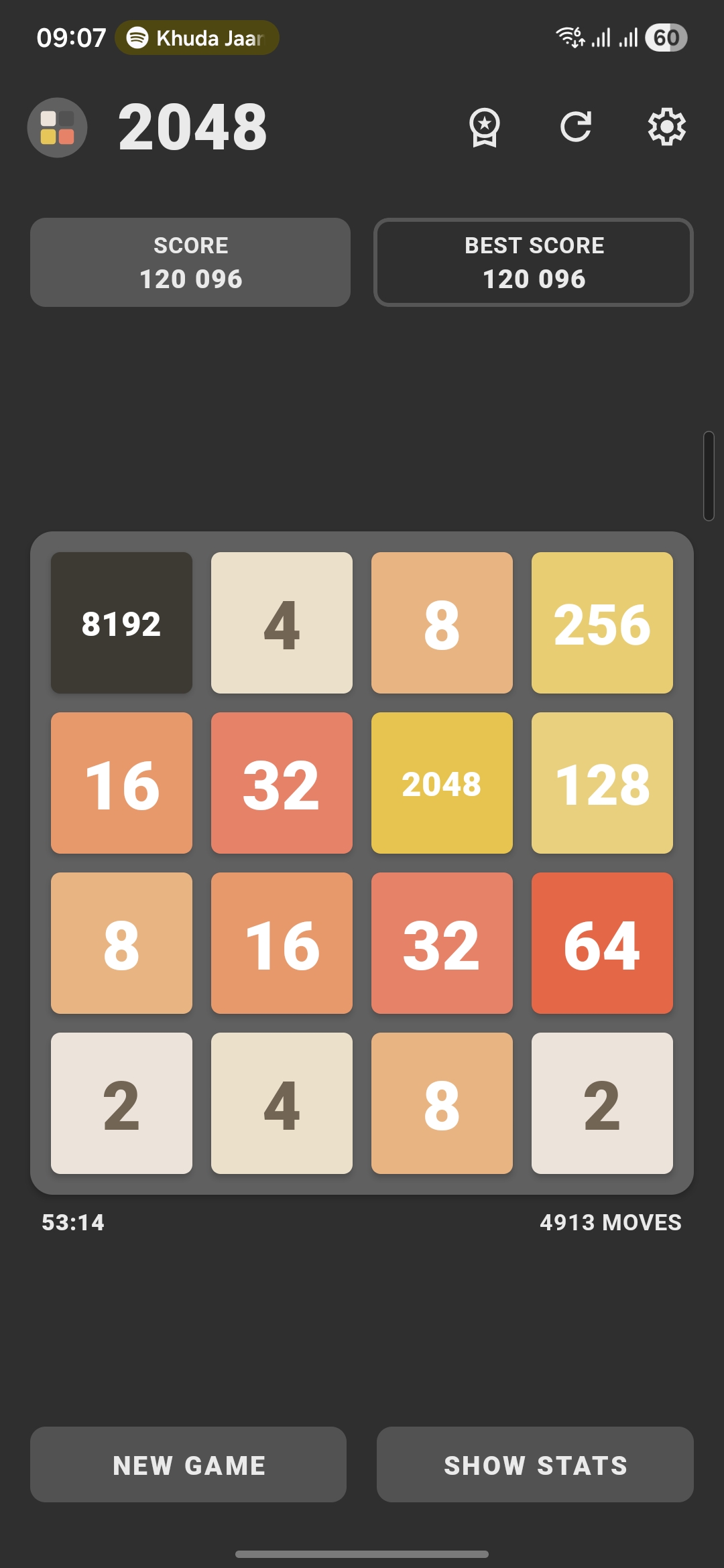
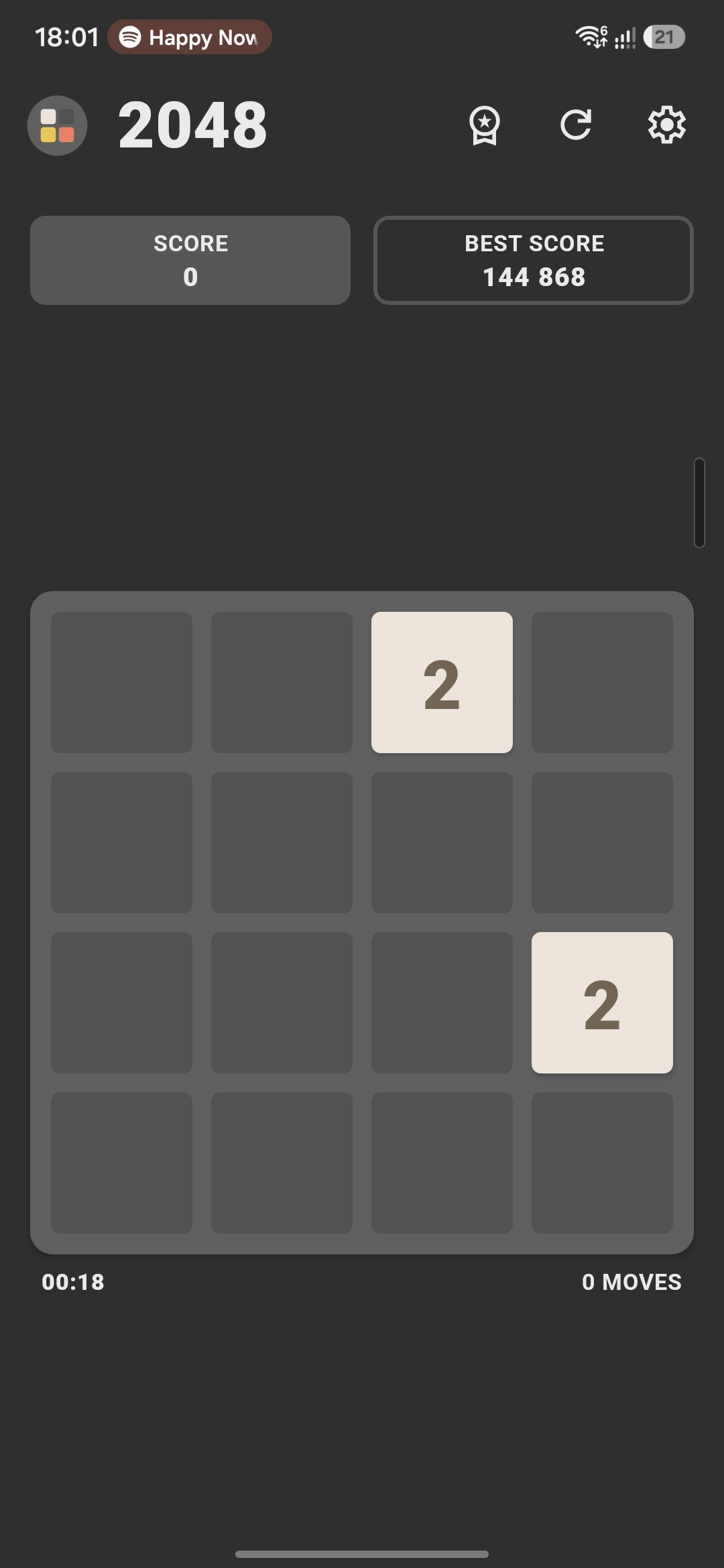
the benchmark to reach: 144,868 points. in version 4, my goal is consistent 8k+ games and reaching 16,384, 32,768, and 65,536 tiles.
technical notes
engine evolution
version 1: expectimax lookahead backed by a tensorflow.js neural network board evaluator. in-browser inference was heavy (>100ms per move), bottlenecking search tree depth.
version 2: replaced tensorflow.js with a pure javascript matrix engine (<0.03ms). but performance dropped to ~512 average tile -- scalar mse regression lost spatial board topology, and shallow depth 2 lookahead was vulnerable to tactical traps.
version 3: n-tuple network trained via temporal difference learning (td) across 100,000 self-play games on kaggle.
version 4 (current): compiled webassembly bitboard expectimax with 16-bit monotonic row/column score maps, hard perimeter anchor invariants, and 64-bit zobrist transposition caching (>10,000 nodes/sec in-browser lookahead, reaching 16,384, 32,768, and 65,536 tiles).
- compiled webassembly (c): sub-millisecond bitboard search executing millions of evaluations per second in-browser.
- 16-bit monotonic score maps: 65,536-entry precomputed row and column evaluation tables rewarding monotonic gradients and merge pairs.
- hard perimeter anchor invariants: topological protection locking the highest tile to the top-left corner.
- 64-bit zobrist transposition table: 131,072-entry cache avoiding redundant search tree exploration.
- depth 5-6 expectimax: deep forward lookahead with selective chance pruning (<10ms latency).
- real-time decision telemetry: live softmax probability distribution and lookahead stats.
built with
webassembly (c), vanilla javascript, html5/css3.